Quick Start with the `difNLR()` function
Source:vignettes/difNLR-quick_start.Rmd
difNLR-quick_start.RmdThis vignette demonstrates the basic usage of the
difNLR() function using example data from the
package.
Load data
We here use the GMAT dataset. It is s a generated
dataset based on parameters from Graduate Management Admission Test
(GMAT, Kingston et al., 1985). First two items were considered to
function differently in uniform and non-uniform way respectively. The
dataset represents responses of 2,000 subjects to multiple-choice test
of 20 items. A correct answer is coded as 1 and incorrect answer as 0.
The column group represents group membership, where 0 indicates
reference group and 1 indicates focal group. Groups are the same size
(i.e. 1,000 per group). The distributions of total scores (sum of
correct answers) are the same for both reference and focal group
(Martinkova et al., 2017).
data(GMAT)
Data <- GMAT[, 1:20] # binary items
group <- GMAT[, "group"] # group membership variable

summary(Data)
## Item1 Item2 Item3 Item4
## Min. :0.000 Min. :0.0000 Min. :0.0000 Min. :0.000
## 1st Qu.:0.000 1st Qu.:0.0000 1st Qu.:0.0000 1st Qu.:1.000
## Median :1.000 Median :1.0000 Median :1.0000 Median :1.000
## Mean :0.525 Mean :0.5695 Mean :0.7135 Mean :0.782
## 3rd Qu.:1.000 3rd Qu.:1.0000 3rd Qu.:1.0000 3rd Qu.:1.000
## Max. :1.000 Max. :1.0000 Max. :1.0000 Max. :1.000
## Item5 Item6 Item7 Item8
## Min. :0.0000 Min. :0.000 Min. :0.0000 Min. :0.0000
## 1st Qu.:1.0000 1st Qu.:0.000 1st Qu.:0.0000 1st Qu.:0.0000
## Median :1.0000 Median :1.000 Median :1.0000 Median :1.0000
## Mean :0.8145 Mean :0.639 Mean :0.6505 Mean :0.6175
## 3rd Qu.:1.0000 3rd Qu.:1.000 3rd Qu.:1.0000 3rd Qu.:1.0000
## Max. :1.0000 Max. :1.000 Max. :1.0000 Max. :1.0000
## Item9 Item10 Item11 Item12
## Min. :0.000 Min. :0.0000 Min. :0.0000 Min. :0.000
## 1st Qu.:0.000 1st Qu.:0.0000 1st Qu.:0.0000 1st Qu.:0.000
## Median :1.000 Median :1.0000 Median :1.0000 Median :1.000
## Mean :0.579 Mean :0.5755 Mean :0.6745 Mean :0.548
## 3rd Qu.:1.000 3rd Qu.:1.0000 3rd Qu.:1.0000 3rd Qu.:1.000
## Max. :1.000 Max. :1.0000 Max. :1.0000 Max. :1.000
## Item13 Item14 Item15 Item16
## Min. :0.000 Min. :0.000 Min. :0.000 Min. :0.0000
## 1st Qu.:0.000 1st Qu.:0.000 1st Qu.:0.000 1st Qu.:0.0000
## Median :1.000 Median :0.000 Median :1.000 Median :0.0000
## Mean :0.742 Mean :0.444 Mean :0.523 Mean :0.4475
## 3rd Qu.:1.000 3rd Qu.:1.000 3rd Qu.:1.000 3rd Qu.:1.0000
## Max. :1.000 Max. :1.000 Max. :1.000 Max. :1.0000
## Item17 Item18 Item19 Item20
## Min. :0.0000 Min. :0.0000 Min. :0.0000 Min. :0.0000
## 1st Qu.:0.0000 1st Qu.:0.0000 1st Qu.:0.0000 1st Qu.:0.0000
## Median :0.0000 Median :0.0000 Median :0.0000 Median :0.0000
## Mean :0.4525 Mean :0.4105 Mean :0.4825 Mean :0.4125
## 3rd Qu.:1.0000 3rd Qu.:1.0000 3rd Qu.:1.0000 3rd Qu.:1.0000
## Max. :1.0000 Max. :1.0000 Max. :1.0000 Max. :1.0000
table(group)## group
## 0 1
## 1000 1000DIF detection with generalized logistic regression models
Not constrained 4 parameter logistic (PL) model using the IRT parametrization is of the following form: where is the matching criterion (e.g., standardized total score) and is a group membership variable for respondent . Parameters , , , and are discrimination, difficulty, guessing, and inattention for the reference group for item . Terms , , , and then represent differences between the focal and reference groups in discrimination, difficulty, guessing, and inattention for item , respectively.
To perform DIF detection, besides Data and
group variable, we need to specify the name of the focal
group with the argument focal.name and the generalized
regression model through the model argument. The options
are as follows: for 1PL model with discrimination parameter fixed on
value 1 for both groups, for 1PL model with discrimination parameter set
the same for both groups, for logistic regression model, for 3PL model
with fixed guessing for both groups, for 3PL model with fixed
inattention for both groups, (alternatively also ) for 3PL regression
model with guessing parameter, for 3PL model with inattention parameter,
for 4PL model with fixed guessing and inattention parameter for both
groups, (alternatively also ) for 4PL model with fixed guessing for both
groups, (alternatively also ) for 4PL model with fixed inattention for
both groups, or for 4PL model.
Here we use the 3PL model with the same guessing parameter
for both groups on the GMAT dataset.
(x <- difNLR(Data, group, focal.name = 1, model = "3PLcg"))## Detection of all types of differential item functioning
## using the generalized logistic regression model
##
## Generalized logistic regression likelihood ratio chi-square statistics
## based on 3PL model with fixed guessing for groups
##
## Parameters were estimated using non-linear least squares
##
## Item purification was not applied
## No p-value adjustment for multiple comparisons
##
## Chisq-value P-value
## Item1 82.0689 0.0000 ***
## Item2 28.3232 0.0000 ***
## Item3 0.6845 0.7102
## Item4 3.3055 0.1915
## Item5 1.1984 0.5492
## Item6 0.1573 0.9244
## Item7 8.3032 0.0157 *
## Item8 2.8660 0.2386
## Item9 0.4549 0.7966
## Item10 1.3507 0.5090
## Item11 1.2431 0.5371
## Item12 1.0537 0.5905
## Item13 4.4139 0.1100
## Item14 1.4940 0.4738
## Item15 1.3079 0.5200
## Item16 0.1424 0.9313
## Item17 3.1673 0.2052
## Item18 2.0206 0.3641
## Item19 6.2546 0.0438 *
## Item20 3.4871 0.1749
##
## Signif. codes: 0 '***' 0.001 '**' 0.01 '*' 0.05 '.' 0.1 ' ' 1
##
## Detection thresholds: 5.9915 (significance level: 0.05)
##
## Items detected as DIF items:
## Item1
## Item2
## Item7
## Item19The functions computes -statistics and corresponding p-values, suggesting items 1, 2, 7, and 19 to function differently for the reference and focal groups.
Plot item characteristic curves
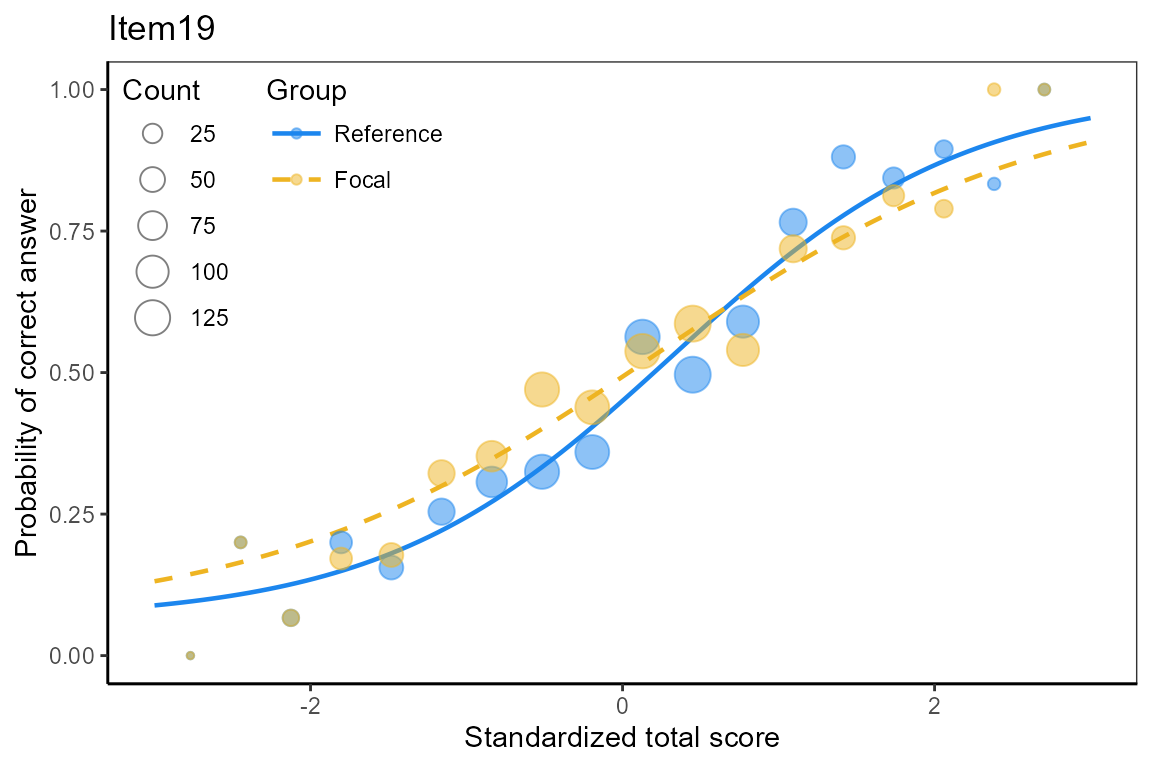
We plot item characteristic curves for DIF items.
plot(x, item = x$DIFitems)## $Item1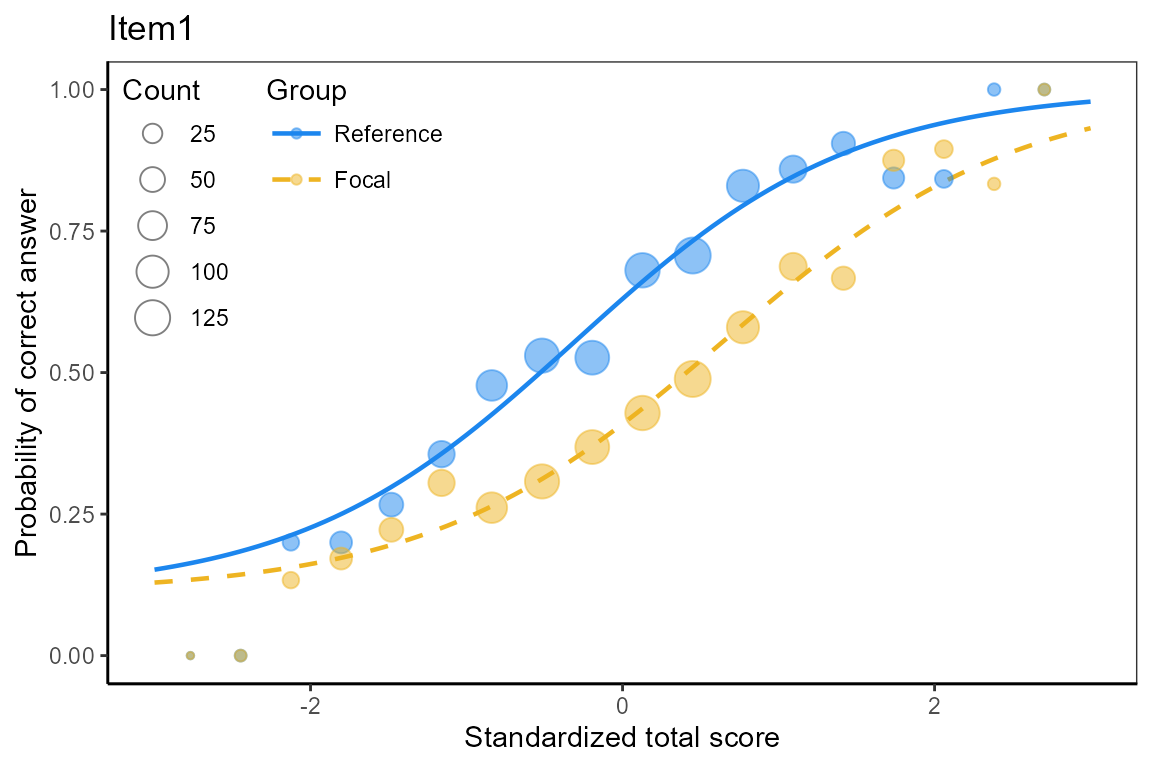
##
## $Item2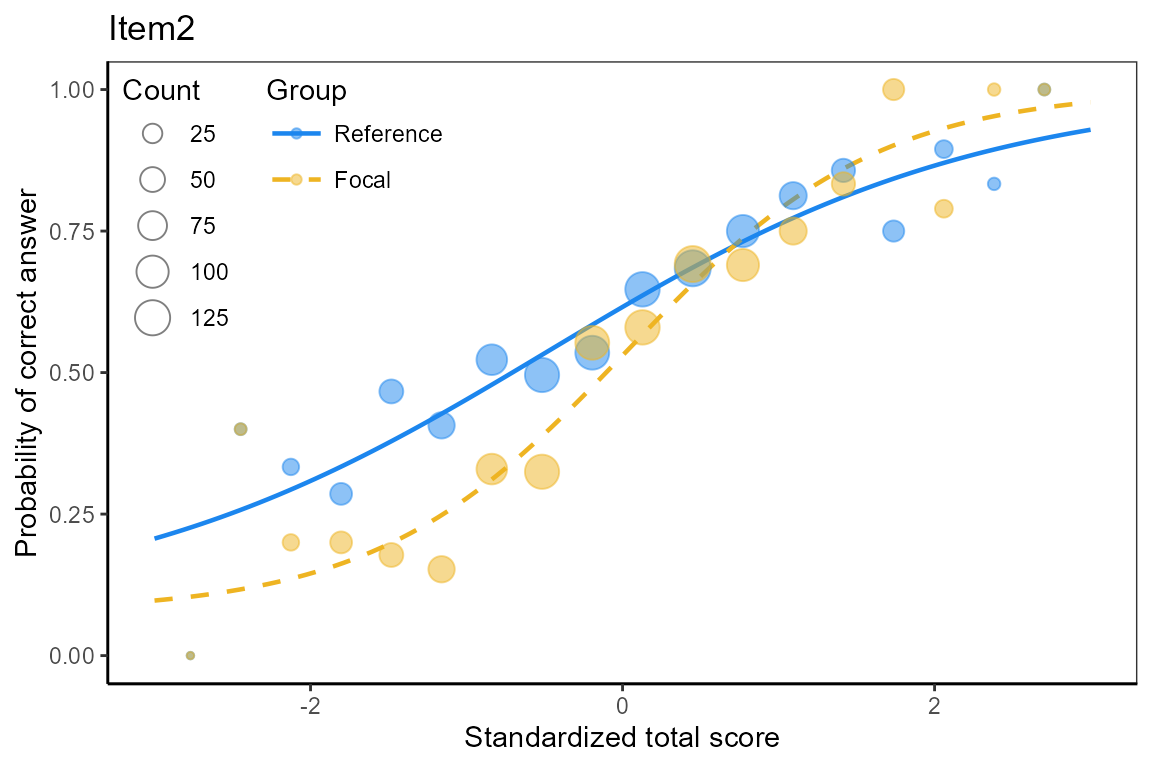
##
## $Item7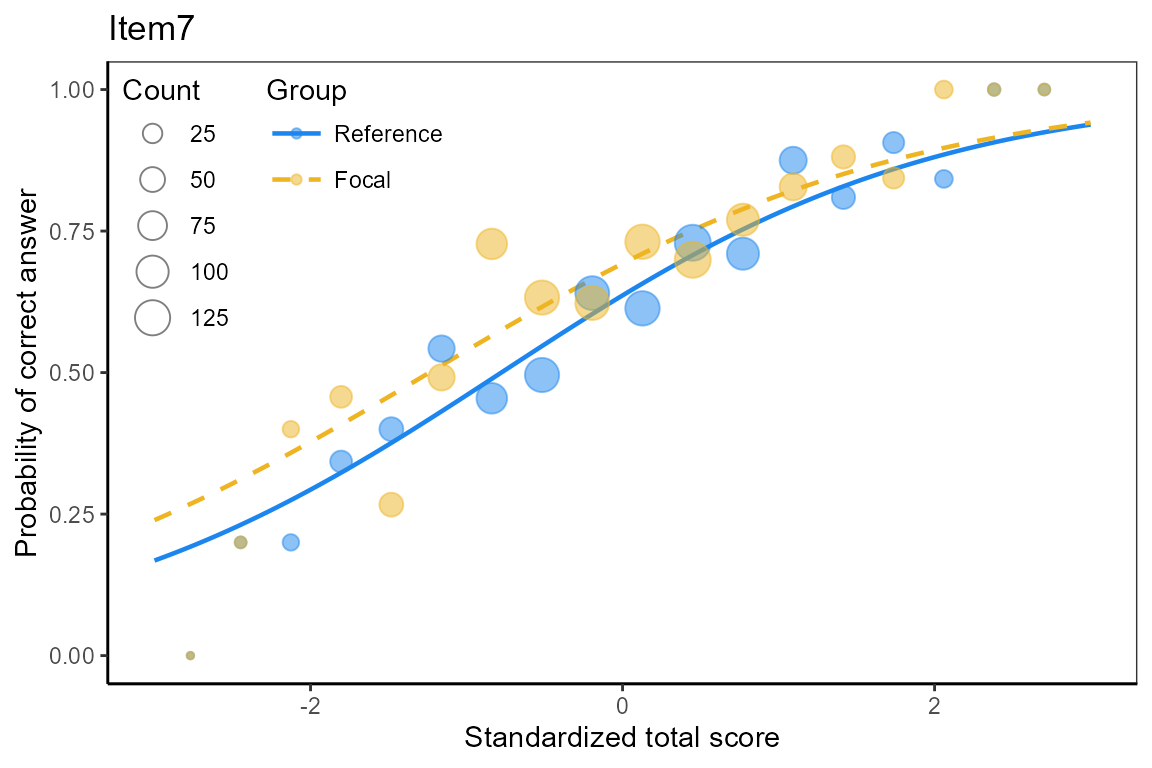
##
## $Item19